Taking the first step toward recovery isn’t just hard – it can be downright terrifying. For many people, what holds them back isn’t just the fear of the unknown or the fear of failure. It’s misinformation. Somewhere along the way, they picked up a belief, whether from the media, social circles, or personal assumptions, that treatment is cold, clinical, and only for people who have ‘hit rock bottom.’
The truth? Treatment facilities today are evolving fast. Especially at Monarch Recovery Centers, where the environment is modern, welcoming, and designed for real healing, not punishment. If you’re interested in learning more about the five most common myths about treatment centers that might be holding you or a loved one back from getting help, we’re happy to assist. Keep reading to discover more about these myths and debunk the stigma together.
Quick Answer Summary
Many people delay seeking addiction treatment because of common misconceptions about recovery programs. In reality, treatment is not only for people who have “hit rock bottom”; modern facilities are often welcoming and supportive, but many programs also allow individuals to continue working or caring for family responsibilities, and treatment can be effective even after previous relapses. Early intervention, personalized care, and ongoing support significantly improve the chances of long-term recovery and overall well-being.
Key Takeaways
- You do not need to hit “rock bottom” before seeking addiction treatment; early intervention often leads to better recovery outcomes.¹
- Modern treatment facilities are designed to promote healing, safety, comfort, and emotional well-being rather than punishment or isolation.
- Many treatment programs, including intensive outpatient programs (IOPs), allow individuals to continue working, attending school, or caring for family responsibilities while receiving support.²
- Seeking treatment is a sign of strength and self-care, not weakness or failure.¹
- Relapse does not mean treatment has failed; recovery is often a long-term process that may involve multiple stages of growth and learning.²
- Individualized treatment plans are more effective than one-size-fits-all approaches because every person’s recovery journey is different.²
- Financial concerns should not prevent someone from exploring treatment options, as insurance coverage and payment assistance may be available.³
- Recovery involves improving health, wellness, and quality of life, not simply stopping substance use.¹
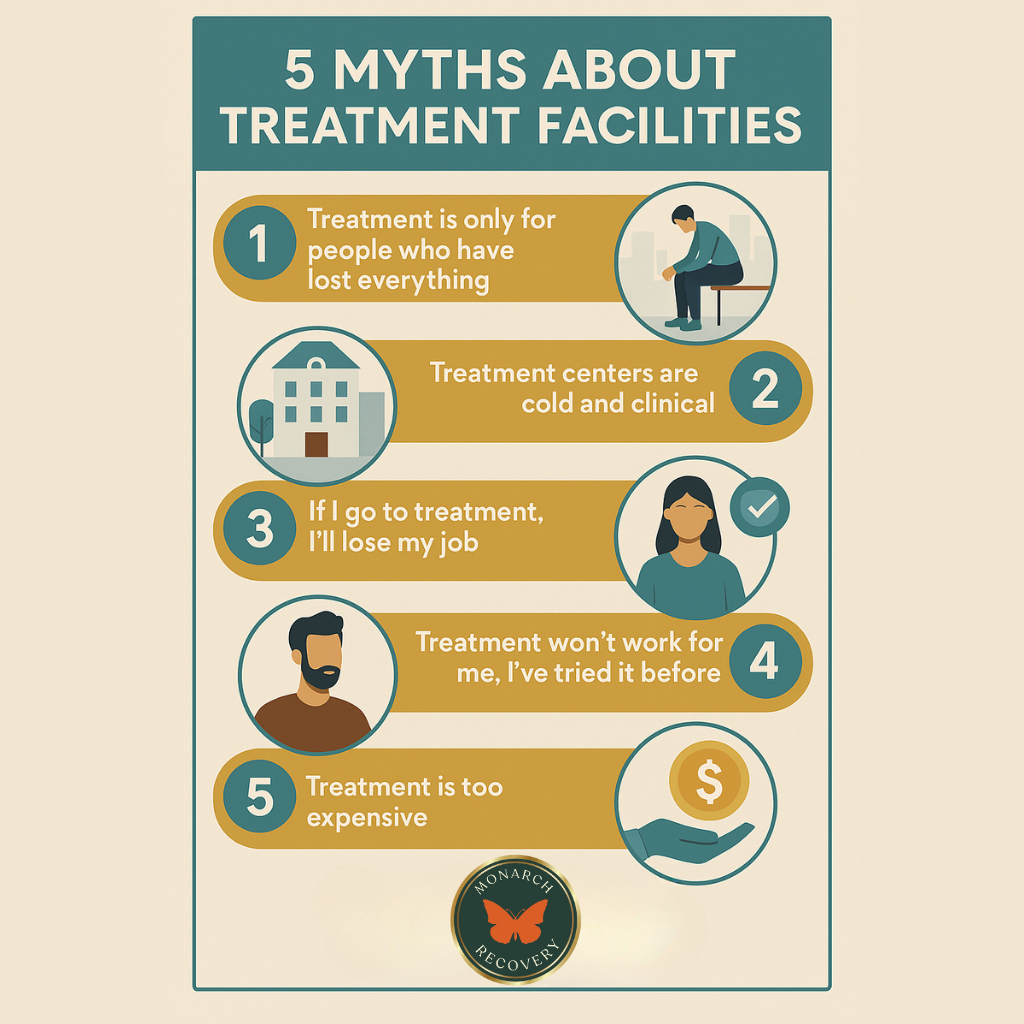
Myth: “Treatment Is Only for People Who Have Lost Everything”
One of the most harmful misconceptions out there is that you have to be at your lowest point before you’re ‘eligible’ for help. Maybe that means being homeless, unemployed, or completely estranged from your family.
The reality is that you don’t have to lose everything to need treatment. Many people seek support before they hit a crisis point. In fact, early intervention can help prevent serious consequences down the line. Monarch’s doors are open to individuals at all stages of their recovery journey, whether you’re newly sober, coming out of detox or realizing your substance use is interfering with your goals. You deserve help now, not just when things get worse.
Myth: “Treatment Centers are Cold, Clinical and Institutional”
Pop culture really hasn’t done treatment facilities any favors. Too often, they’re portrayed as sterile environments with hospital beds and harsh fluorescent lights.
The reality is that a high-quality treatment facility is designed to feel safe, welcoming, and restorative. At Monarch Recovery Centers, that means open-concept spaces, comfortable furniture, inclusive artwork, and even indoor/outdoor environments with koi ponds and trees. These intentional design choices support emotional healing by reducing stress and promoting calm.
Myth: “If I Go to Treatment, I’ll Lose My Job or Be Judged”
Fear of judgment from employers, coworkers, or friends is a huge barrier. There’s a common belief that going to rehab equals failure or weakness.
The reality is that seeking treatment is a sign of strength, not weakness. And there are protections in place to help you do it discreetly. Laws like the Family and Medical Leave Act (FMLA) allow qualifying individuals to take time off of work for medical reasons, including substance use treatment, without losing their job.
At Monarch, we also offer Intensive Outpatient Programs (IOP) for those who need support while still maintaining work or family obligations. These flexible options let you prioritize your health without pressing pause on your entire life.
Myth: “Treatment Won’t Work for Me, I’ve Tried It Before”
Maybe you, or someone you love, has been through treatment before and unfortunately relapsed. It’s easy to believe that another program will just be more of the same thing.
The reality is that recovery isn’t linear, and each and every attempt is a step forward. At Monarch, we believe that individualized care can make all the difference. No one is given a cookie-cutter plan. Our clinical and experiential programs are tailored to your unique needs, triggers, background, and goals, helping you succeed. If past programs didn’t stick, it’s not because you failed. It’s because you hadn’t found the right approach yet – that’s what Monarch is here to offer.
Myth: “Treatment is Too Expensive – There’s No Way I Can Afford It”
Worries about cost are legitimate, especially when insurance coverage is unclear or limited.
The reality is that many treatment centers near me, including Monarch, work with a wide range of insurance providers, and your care may be partially or fully covered depending on your plan. Our admissions team helps clients understand their options, check their benefits, and explore payment plans when needed. Don’t let assumptions stop you. Ask the questions, explore the options, and know that financial support may be more accessible than you think.
You Don’t Have to Hit Rock Bottom to Start Recovery
Treatment doesn’t always have to be a last resort, and it doesn’t have to be clinical, cold or unaffordable. And it definitely doesn’t mean that you’ve failed; it means that you’re choosing to show up for yourself. If you’ve been typing treatment centers near me into your search bar but hesitating to click, we hope this helps bring you one step closer to saying yes.
At Monarch Recovery Centers, we’ve built a modern, compassionate treatment facility designed to support real, long-term recovery, not just sobriety. With flexible programs, upscale environments and personalized care, we’re here to help you take the first step towards lasting change. You don’t have to hit rock bottom – you just have to start.
Ready to take that first step? Contact us today, and our team will be happy to walk you through the process.
Citations
- Substance Abuse and Mental Health Services Administration (SAMHSA). Recovery and Recovery Support. https://www.samhsa.gov/recovery
- National Institute on Drug Abuse (NIDA). Treatment and Recovery. https://nida.nih.gov/publications/drugs-brains-behavior-science-addiction/treatment-recovery
- National Institute on Alcohol Abuse and Alcoholism (NIAAA) – Treatment for Alcohol Problems: Finding and Getting Help. https://www.niaaa.nih.gov/publications/brochures-and-fact-sheets/treatment-alcohol-problems-finding-and-getting-help