
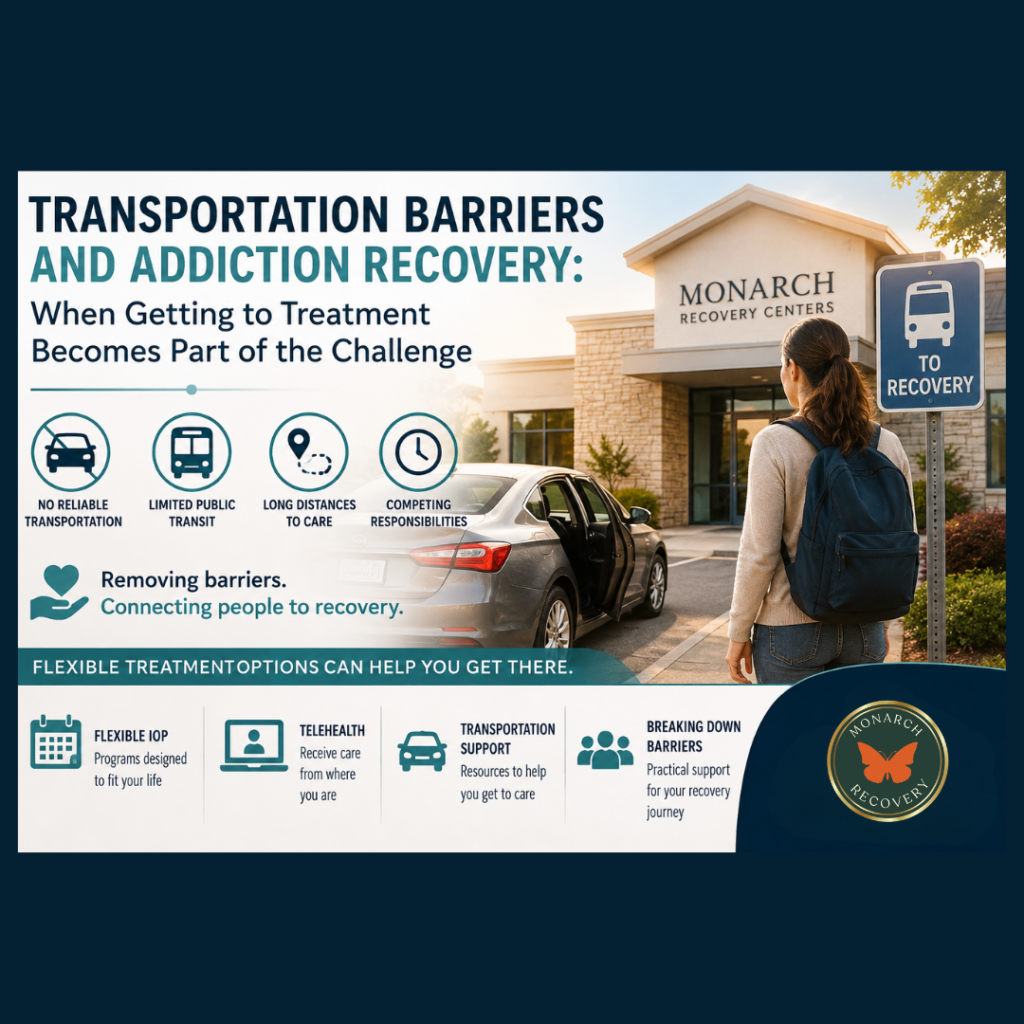
Deciding to seek addiction treatment can already require navigating uncertainty, changing routines, and asking for support. Getting to treatment should be the simple part, but for so many people, it isn’t.
Not having a reliable car, living far from a treatment provider, depending on someone else for rides, or dealing with limited public transportation can turn every appointment into a logistical puzzle. Add work, childcare, school, and other responsibilities, and attending treatment several times each week may become increasingly difficult. Transportation is more than an inconvenience when it interferes with healthcare. Research has identified transportation and long travel distances as meaningful barriers to accessing substance use disorder treatment, particularly in communities where services are limited.¹³
At Monarch Recovery Centers, the goal is to help remove practical barriers to addiction treatment wherever possible. Transportation support, flexible outpatient programming, and telehealth addiction treatment can provide different ways for patients to stay connected to care when getting to every appointment proves difficult. This commitment is part of Monarch’s broader Breaking Down Barriers approach to making recovery services more accessible.
Why Transportation Can Become a Barrier to Treatment
Transportation challenges look different for everyone. Someone may have a car but be unable to afford an unexpected repair, while another person may rely on public transportation that does not run near their treatment center. Someone else might share a vehicle with a partner who needs it for work or depend on friends and family members whose schedules change from week to week. The challenge can become even greater when treatment involves frequent appointments.
SAMHSA specifically includes the inability to obtain transportation among the barriers that people can experience when trying to access substance use services. Its guidance for people preparing to begin treatment also recommends planning transportation in advance and asking healthcare providers or support networks about available assistance.2 In other words, transportation problems should not be automatically interpreted as a lack of commitment to recovery. Sometimes, getting through the door is really the obstacle.
Transportation Challenges Can Affect Consistency
Beginning treatment is important, but remaining engaged matters, too. Outpatient treatment often involves recurring appointments rather than a single visit. If every session requires coordinating rides, paying for transportation or rearranging other responsibilities, those demands can accumulate quickly.
Recent research illustrates how significant this barrier can be. In a transportation-support initiative associated with the HEALing Communities Study in Kentucky, nearly 85% of a surveyed subgroup receiving services identified transportation as a major barrier to obtaining or staying in treatment for opioid use disorder. Assistance included options such as rides to appointments, bus passes, vehicle repairs, and other transportation services.4
The specific solution will vary by person and community. The broader lesson is that practical support can be an important part of making treatment accessible. For someone participating in an intensive outpatient program, reducing logistical barriers can make it more realistic to maintain the consistent schedule that treatment requires.
Getting to IOP While Managing Everyday Life
Transportation rarely exists as an isolated problem. Imagine someone who works until late afternoon and needs to attend IOP afterward – they may need to leave work, pick up a child, coordinate childcare, find transportation to treatment, attend programming, and then arrange a way home. A missed bus or canceled ride can quickly unravel the entire plan.
This is why accessibility involves more than simply having a treatment program available. Care also needs to be realistically reachable. SAMHSA’s current guidance on low-barrier substance use disorder care emphasizes reducing requirements and restrictions that unnecessarily limit access to treatment.1 Flexible intensive outpatient treatment can be part of that broader effort by allowing appropriate patients to receive structured support while continuing to manage many of their daily responsibilities.
Can Someone Receive Treatment Without Transportation?
For some services and patients, yes. Telehealth has expanded the ways that behavioral healthcare can be delivered, allowing appropriate portions of treatment to take place virtually instead of requiring travel for every interaction.
For someone seeking treatment without transportation, virtual care can reduce the number of trips required and make ongoing therapy easier to fit around work, parenting or school. Patients may be able to participate in telehealth addiction treatment from home or another appropriate private location while remaining connected to scheduled clinical care.
It’s important to note that telehealth is not appropriate for every person or every service. Some aspects of addiction treatment require in-person care, and some patients need a higher level of clinical or medical support than virtual treatment can provide.
Hybrid Care Can Reduce the Travel Burden
Treatment also does not have to be entirely virtual or entirely in person. Hybrid care combines both formats based on clinical needs and the services being provided. Someone might attend certain appointments onsite while participating in appropriate counseling or other programs virtually. This can be especially useful when transportation is available occasionally but difficult to arrange several times per week.
Hybrid care preserves opportunities for face-to-face treatment while using technology to reduce unnecessary travel. It can also help patients adapt when circumstances change, such as losing access to a vehicle, changing jobs, moving farther from treatment or taking on new family responsibilities. The result is a treatment plan that is designed around both clinical needs and the realities of everyday life.
Transportation Support Is Part of Breaking Down Barriers
Technology is only one piece of the accessibility puzzle. Sometimes a patient needs to attend an in-person service and simply needs a reliable way to get there. This is where transportation assistance for addiction treatment in Sacramento and other practical support resources can become especially important.
Transportation assistance can take different forms depending on the provider, program, eligibility requirements, and available resources. Research into transportation interventions for opioid use disorder has examined strategies ranging from bus passes and rideshare services to agency transportation and fuel assistance.4
For treatment providers, recognizing these needs is part of seeing the whole person. Recovery takes place alongside housing concerns, jobs, family relationships, financial responsibilities, and transportation needs. Helping patients navigate those circumstances can make clinical treatment more accessible and sustainable.
Accessibility Should Not Mean Less Accountability
Removing barriers does not mean removing structure. Patients participating in IOP and outpatient treatment still follow treatment plans, attend scheduled sessions, communicate with clinicians, and work toward recovery goals. Telehealth and transportation support simply create more ways to maintain those connections.
This distinction matters. The purpose of flexible care is not to lower expectations for recovery, but rather to prevent solvable logistical problems from becoming an unnecessary obstacle to receiving appropriate care.
Breaking Down Transportation Barriers to Addiction Recovery
A person can be ready for treatment and still have no reliable way to get there. Recognizing that reality changes the conversation – instead of asking why someone missed an appointment, providers can also ask what made the appointment difficult to attend and whether another solution is available.
At Monarch Recovery Centers, our broader approach to recovery support services in Sacramento is built around helping patients navigate the real-life circumstances that affect treatment participation. Through flexible intensive outpatient services, telehealth treatment, and practical accessibility support, we work to make recovery easier to react without sacrificing meaningful structure and accountability.
If transportation concerns are making you wonder whether treatment is realistic, contact us today. Our team will be happy to help you explore available care options and determine how treatment can best fit your clinical needs, schedule, and circumstances.
Citations:
- Substance Abuse and Mental Health Services Administration. Breaking Down Barriers to Treatment. https://www.samhsa.gov/substance-use/treatment/integrating-sud-services/breaking-barriers
- Substance Abuse and Mental Health Services Administration. Connecting Communities to Substance Use Services: Practical Tools for First Responders. https://store.samhsa.gov/sites/default/files/pep23-06-01-010.pdf
- Joudrey, P. J., et al. Barriers to Opioid Use Disorder Treatment Among People Who Use Drugs in the Rural United States: A Qualitative, Multi-Site Study. https://pmc.ncbi.nlm.nih.gov/articles/PMC10997882/
- Analysis of the Costs and Reach of Transportation Services to Reduce Barriers to Opioid Use Disorder (OUD) Treatment: Evidence from the Kentucky HEALing Communities Study. https://pubmed.ncbi.nlm.nih.gov/42477841/