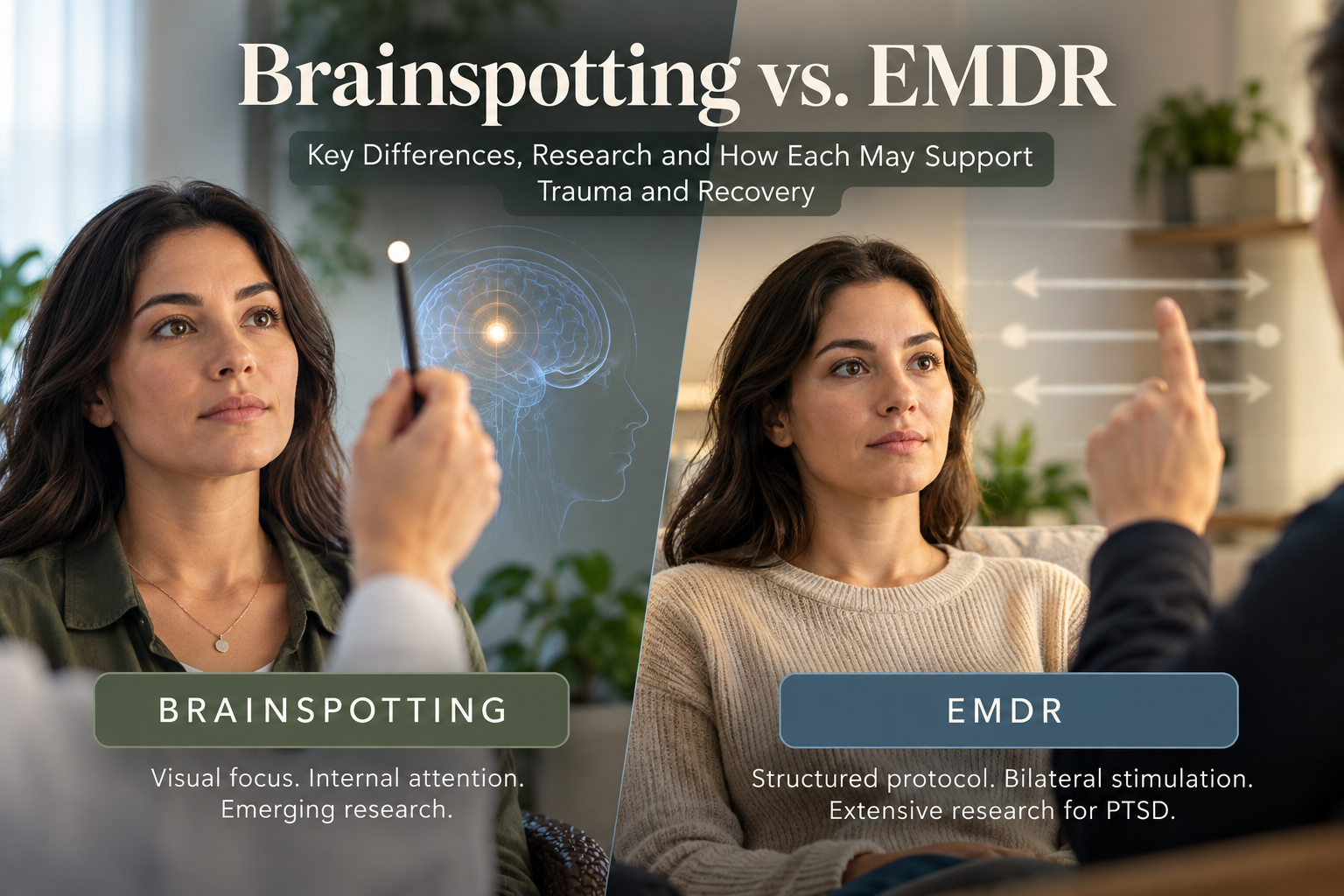

When people begin exploring therapy for trauma or significant emotional distress, they may encounter treatments that sound similar on the surface. Brainspotting and Eye Movement Desensitization and Reprocessing (EMDR), for example, both involve visual attention and encourage people to notice internal responses connected with difficult experiences. However, they are not the same therapy.
EMDR follows a structured, multi-phase treatment protocol and incorporates bilateral stimulation while a person works with trauma-related memories, beliefs, emotions and physical sensations. Brainspotting generally uses a particular point in the visual field as a focal point while the client notices what emerges internally. There is also an important difference in the amount of research supporting each approach. EMDR has been extensively studied as a treatment for posttraumatic stress disorder (PTSD), while research on Brainspotting remains much more limited at the moment.
For someone exploring trauma therapy in Sacramento, understanding these differences can make a conversation with a treatment provider that much more productive. The question doesn’t necessarily need to be which therapy is ‘better,’ but rather which approach is appropriate for a person’s symptoms, preferences, treatment goals and broader recovery plan.
Quick Answer Summary
What Is the Difference Between Brainspotting and EMDR?
Brainspotting and EMDR are trauma-focused therapy approaches that use visual attention differently. EMDR follows a structured, multi-phase protocol that incorporates bilateral stimulation and has an extensive research base for PTSD. Brainspotting uses a specific point in the visual field to support focused attention on internal experiences and currently has a much smaller evidence base. The appropriate approach depends on a person’s symptoms, preferences, clinical needs and overall treatment plan.
Key Takeaways
- Brainspotting and EMDR are different therapeutic approaches. EMDR uses a structured, eight-phase protocol and bilateral stimulation, while Brainspotting typically uses sustained visual focus as the client notices internal experiences.¹ ²
- EMDR has substantially more research supporting its use for PTSD. Numerous randomized controlled trials have evaluated EMDR, and major clinical guidelines recommend it as a trauma-focused psychotherapy for PTSD.²
- Research on Brainspotting remains limited and emerging. A 2025 randomized study reported encouraging findings but also identified important limitations and called for additional randomized controlled trials.³
- Neither approach necessarily requires repeatedly describing every detail of a traumatic experience. Both can include periods in which the client attends to thoughts, emotions, memories or physical sensations without continuously narrating them.²
- Trauma treatment should be individualized and trauma-informed. Safety, collaboration, empowerment and patient choice are important considerations when determining how trauma-focused work fits into a broader treatment plan.⁴
- Brainspotting may be incorporated into addiction recovery when clinically appropriate, but it does not replace comprehensive addiction treatment. Trauma can intersect with substance use and behavioral health concerns, while individual responses and treatment needs vary.⁵
What Is Brainspotting?
Brainspotting is a psychotherapy approach developed in the early 2000s. It grew partly out of observations made during trauma therapy involving eye position. During Brainspotting therapy, a therapist typically helps the client identify an emotionally meaningful concern and notice the thoughts, feelings, memories or physical sensations associated with it. The therapist and client then identify a particular point within the client’s visual field, sometimes called a ‘brainspot.’ The client maintains visual attention around that location while observing their internal experience.
Published papers about Brainspotting have proposed neurological explanations for why visual position and focused attention might be relevant to emotional processing. However, these papers explicitly describe those mechanisms as hypotheses rather than established neurological facts.1 The experience might therefore be described more simply: Brainspotting creates a focused therapeutic setting in which someone can notice and explore emotional responses connected with a difficult experience.
What Is EMDR?
EMDR is a structured trauma-focused psychotherapy that was originally developed by psychologist Francine Shapiro. Treatment generally follows eight phases that include history taking, preparation, assessment, processing trauma-related material and reevaluation.
During the processing portions of EMDR, a client may focus on trauma-related memory, associated negative belief, emotions and physical sensations while engaging in alternating bilateral stimulation. This can involve following a therapist’s hand with their eyes, tapping, tones or other forms of alternating right-left stimulation.2 The therapist then guides the client through repeated sets while monitoring what emerges.
Unlike Brainspotting, EMDR has been evaluated in numerous randomized controlled trials for PTSD. The US Department of Veterans Affairs’ National Center for PTSD identifies EMDR as one of the most studied treatments for PTSD and notes that it receives a strong recommendation in several major clinical practice guidelines.2 This distinction matters when comparing the two approaches. It doesn’t determine which therapy an individual receives, but it does describe the current state of the evidence accurately.
Brainspotting vs. EMDR: What Might Feel Different?
From the patient’s perspective, one of the clearest differences may be how structured each experience feels. EMDR follows a defined treatment protocol. Before trauma processing begins, the therapist gathers history, explains the process and helps the client develop strategies for managing distress. The therapist and the client then identify specific treatment targets and related beliefs, emotions and physical sensations. During processing, the therapist leads repeated sets of bilateral stimulation and checks in about what the client notices.
Brainspotting generally involves a different rhythm. Once a visual focal point has been identified, the therapist may allow more sustained periods of attention while the client notices what emerges. There may be less frequent direction from the therapist during portions of the processing experience.
Neither description means that the person is simply left alone with difficult emotions. The therapeutic relationship, preparation, pacing and attention to safety remain important. But someone who prefers a clearly defined sequence of treatment steps may experience EMDR differently than someone who responds well to more open-ended internal attention that can occur during Brainspotting therapy in Sacramento.
Do You Have to Talk About the Trauma?
Both approaches may appeal to people who are uncomfortable with the idea of repeatedly describing every detail of a traumatic experience. EMDR still involves identifying a target memory and aspect associated with it, including negative beliefs, emotional distress and physical sensations. However, the client doesn’t necessarily need to provide a detailed verbal account of everything that arises during each processing set.2
Brainspotting can similarly involve relatively little verbal narration during periods of focused attention. A person may notice sensations, memories, images or thoughts without continuously explaining them to the therapist.
This doesn’t mean that either therapy is ‘nonverbal’ or that communication is unnecessary. Rather, therapists will still need information in order to understand what the client is experiencing, assess safety, plan treatment and determine whether the approach remains appropriate.
What Does the Research Say?
This is one of the biggest differences between Brainspotting and EMDR. EMDR has decades of research behind it. The VA National Center for PTSD reports that numerous randomized controlled trials have evaluated EMDR and that major clinical guidelines recommend it as a trauma-focused psychotherapy for PTSD.2 Brainspotting has a considerably smaller evidence base.
A 2025 randomized study evaluated Brainspotting combined with cognitive behavioral therapy among people who had experienced singular stressful or traumatic events. Participants receiving Brainspotting earlier showed a stronger early response, while both groups improved by the end of treatment and follow-up. However, the researchers emphasized substantial limitations to generalizing the results and called for additional randomized controlled trials.3
This study does contribute useful information, but it doesn’t put Brainspotting on the same evidentiary footing as EMDR. For patients considering Brainspotting in Sacramento, that context is worth knowing. Emerging evidence can justify continued research and clinical consideration without requiring stronger claims than the research currently supports.
How Does Trauma-Informed Care Fit Into the Decision?
The therapy technique is only one part of the trauma treatment. SAMHSA describes trauma-informed care as an approach that recognizes how trauma can affect people, integrates that knowledge into care and seeks to avoid retraumatization. Important principles include safety, trustworthiness, collaboration, empowerment and choice.4
These principles can matter whether someone is participating in Brainspotting, EMDR, cognitive behavioral therapy or another type of behavioral health treatment. A clinician may consider several factors when discussing treatment options, including the person’s symptoms, history, current stability, previous treatment experiences, comfort with therapeutic approach and overall goals.
It’s important to note that the presence of trauma doesn’t automatically mean that someone needs a particular type of trauma-processing therapy. Treatment should remain individualized rather than beginning with the assumption that one technique is appropriate for everyone.
Where Does Brainspotting Fit Into Addiction Recovery
Trauma and substance use can intersect, but the relationship is complex. SAMHSA notes that traumatic experiences are often associated with behavioral health concerns, including substance use, while also recognizing that people respond to trauma differently.5 Trauma doesn’t explain every substance use disorder, and not everyone receiving addiction treatment needs trauma-focused therapy. However, when trauma-related stress is relevant, addressing it may become one component of treatment.
Brainspotting and addiction recovery may intersect when a clinician determines that difficult experiences or emotional responses are contributing to challenges in recovery. Brainspotting does not replace comprehensive addiction treatment – someone may simultaneously need individual counseling, group therapy, behavioral interventions, relapse-prevention planning, recovery support, medication or other services depending on their needs. Within a broader recovery plan, Brainspotting may offer another way to explore trauma-related or emotionally distressing experiences.
Exploring Brainspotting Therapy and Addiction Recovery in Sacramento
A comparison between Brainspotting and EMDR doesn’t need a winner. EMDR is a structured, trauma-focused psychotherapy with a substantial research base for PTSD and recommendations from major clinical guidelines. Brainspotting is a newer, less extensively studied approach that uses sustained visual focus and internal attention to explore emotional experiences. The experience of each therapy can also feel different. Some may appreciate EMDR’s structured phases and defined processing protocol, while others may be interested in the sustained, internally focused experience associated with Brainspotting. A person’s diagnosis, symptoms, preferences, clinical needs and broader treatment plan can all inform the discussion.
For those exploring trauma therapy in Sacramento alongside addiction recovery, the decision should also account for how trauma-focused work fits within the rest of the treatment. At Monarch Recovery Centers, we are proud to offer Brainspotting therapy in Sacramento as one component that may be incorporated into a broader individualized treatment plan when clinically appropriate. If trauma or emotional distress are affecting your recovery, contact us today to learn more about Brainspotting, addiction treatment and the treatment options that may fit your needs.
Citations:
- Corrigan F, Grand D. (2013). Brainspotting: Recruiting the midbrain for accessing and healing sensorimotor memories of traumatic activation. Medical Hypotheses, 80(6), 759–766. https://pubmed.ncbi.nlm.nih.gov/23570648/
- U.S. Department of Veterans Affairs, National Center for PTSD. Eye Movement Desensitization and Reprocessing for PTSD. This is a particularly strong source for the article because the VA page covers the evidence base, bilateral stimulation, treatment process, RCTs, and clinical-practice-guideline recommendations. https://www.ptsd.va.gov/professional/treat/txessentials/emdr_pro.asp
- Glantschnig S. (2025). Brainspotting after singular stressful/traumatizing experiences: Evaluation of a combination of Brainspotting and cognitive behavioral therapy. Psychotherapie Forum, 29, 59–66. This is the actual Springer article and it is open access. https://link.springer.com/article/10.1007/s00729-025-00275-5
- Substance Abuse and Mental Health Services Administration. Trauma-Informed Approaches and Programs. https://www.samhsa.gov/mental-health/trauma-violence/trauma-informed-approaches-programs
- Substance Abuse and Mental Health Services Administration. Trauma and Violence: What Is Trauma and Its Effects? https://www.samhsa.gov/mental-health/trauma-violence