

Trauma does not affect everyone in the same way. Some people can clearly connect emotional difficulties to a particular experience, while others may notice that certain situations trigger fear, anxiety, anger, avoidance, or physical tension without immediately understanding why. Difficult memories may feel distant at times and unexpectedly intense at others.
These responses are part of what can make trauma complicated to address. Healing is not simply a matter of understanding intellectually that a difficult experience happened in the past. The Substance Abuse and Mental Health Services Administration (SAMHSA) explains that trauma can have lasting effects on mental, physical, emotional, social, and spiritual well-being. Trauma-informed care recognizes these potential effects while emphasizing safety, trust, collaboration, empowerment, and avoiding retraumatization.1
For those exploring trauma therapy Sacramento options, Brainspotting is one approach that they may encounter. Brainspotting therapy in Sacramento can be incorporated into individualized care at Monarch Recovery Centers when clinically appropriate, particularly when trauma or emotional distress is relevant to someone’s broader recovery needs.
Quick Answer Summary
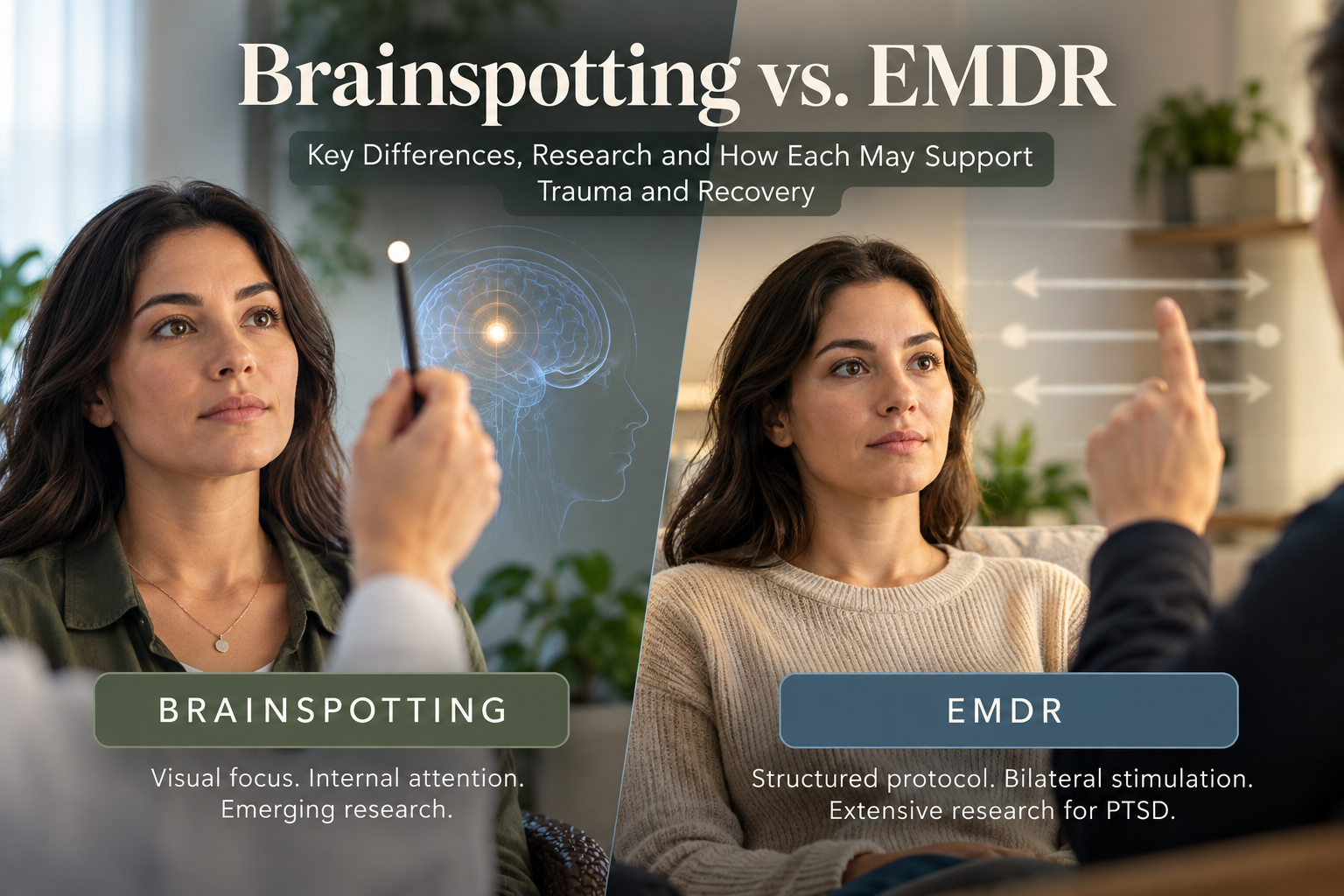
Brainspotting is an emerging trauma-focused therapy that uses visual focus alongside awareness of thoughts, emotions and physical sensations. For some trauma survivors, it may be incorporated into a broader trauma-informed treatment plan, although its research base remains smaller than established trauma therapies such as trauma-focused CBT.³ ⁵
Key Takeaways
- Trauma can affect emotional, physical and behavioral wellbeing long after a difficult experience has ended. Trauma-informed care emphasizes safety, trust, collaboration, empowerment and avoiding retraumatization.¹ ²
- Brainspotting uses visual focus while a patient observes internal experiences. Proposed neurological explanations for the technique remain hypotheses, and its evidence base is still developing.³
- Brainspotting does not necessarily require continuously describing every detail of a traumatic experience. Treatment should still involve communication, appropriate pacing, safety and meaningful patient involvement.⁴
- Brainspotting and established trauma therapies do not currently have equivalent evidence bases. Trauma-focused cognitive behavioral therapies have substantially stronger research support for conditions such as PTSD.⁵
- Trauma-informed therapy can be incorporated into addiction recovery when clinically appropriate. Brainspotting may serve as one component of a broader plan that includes counseling, IOP and other behavioral health and recovery services.⁶
Why Can Trauma Continue to Affect Someone After an Experience Is Over?
Trauma is sometimes described casually as something being ‘stored in the body.’ While this phrase can be relatable, the science is much more nuanced.
People can experience emotional, cognitive, behavioral, social, and physical reactions following trauma. SAMHSA notes that common responses can include fear, sadness, anger, difficulty regulating emotions, changes in thinking, avoidance, sleep disruption, and physical symptoms. Importantly, many people are resilient and recover without developing a trauma-related disorder, while others experience longer-lasting difficulties.2
This means that someone can logically recognize that they are safe while still experiencing a strong reaction to something associated with a previous experience. A particular place, interaction, sound, feeling or stressful situation may bring up an emotional or physical response. Trauma-informed therapy can help individuals understand these patterns and develop ways of responding that support their wellbeing.
The goal of treatment is not to assume that every difficult emotion comes from trauma, but rather to create space to explore whether past experiences are influencing what is actively happening in the present.
What Is Brainspotting?
Brainspotting is a relatively new therapeutic approach developed in the early 2000s. During Brainspotting therapy, a clinician helps the client identify a particular point within their visual field while the client focuses on an emotionally meaningful concern. The person may then maintain their gaze around that point while noticing thoughts, memories, emotions, images, or physical sensations that may arise. Compared with therapies that focus heavily on conversation or thought analysis, Brainspotting may include periods when the patient is primarily observing their internal experience.
The approach’s developers have proposed neurological explanations for why eye position may be relevant to emotional processing. However, published papers describing these mechanisms characterize them as hypotheses. They should therefore not be presented as established explanations of how Brainspotting affects the brain.3 Research into Brainspotting also remains limited compared with other established trauma therapies, an important distinction for patients considering Brainspotting Sacramento services.
What Might a Trauma Survivor Experience During a Session?
Brainspotting is intended to be collaborative rather than something that is ‘done’ to a patient. A session will typically begin with a conversation about what the individual wants to explore. With guidance from a trained therapist, the person may notice how thinking about that subject affects them emotionally or physically. The therapist can then help identify a visual focus point. While maintaining attention around that area, the patient observes what emerges rather than trying to force a particular response.
This experience will not look the same for everyone. Someone may notice a memory, emotion, image, thought or physical sensation, while another may experience something much subtler. At Monarch, Brainspotting therapy services in Sacramento are incorporated into individualized treatment rather than offered as a universal solution for trauma.
Does Brainspotting Require Talking About Every Detail of Trauma?
Not necessarily. Some trauma survivors worry that seeking therapy will require them to immediately recount every detail of a painful experience. Brainspotting can include periods focused more on internal emotional and physical awareness rather than continuous verbal description.
This does not mean that communication disappears from therapy. The clinician still needs to understand the patient’s goals, monitor their response, assess safety, and determine whether the approach remains appropriate. Trauma-informed care also emphasizes avoiding retraumatization and creating an environment where patients have meaningful involvement in their care.4
A qualified therapist should therefore help establish appropriate pacing rather than assuming that revisiting more detail or creating greater emotional intensity automatically means better therapy.
Where Does Brainspotting Fit Among Other Trauma Therapies?
Brainspotting is one of several approaches that someone may encounter when exploring trauma treatment. It’s particularly important not to interpret ‘trauma-focused’ as meaning that all therapies have equivalent evidence behind them. For PTSD, trauma-focused cognitive behavioral therapies have substantial research and evidence-based approaches such as Cognitive Behavioral Therapy (CBT) and Prolonged Exposure are strongly supported in clinical guidelines.5
On the other hand, Brainspotting currently has a much smaller research base. This does not mean that someone cannot find it meaningful or that a qualified clinician cannot incorporate it into care. It means that claims about its effectiveness should remain proportional to the available evidence.
Someone searching for trauma therapy services in Sacramento can discuss the full range of options with a clinician, including which approaches have the strongest evidence for their particular symptoms or diagnosis and whether Brainspotting could complement those treatments.
Trauma and Addiction Recovery Can Intersect
Trauma is also relevant to addiction treatment for many people. Not every person with a substance use disorder has experienced trauma, and having experienced trauma does not mean that someone will develop an addiction. But trauma and substance use can intersect, which is why SAMHSA recommends that behavioral health providers understand trauma and recognize its potential role when providing care.6
For some individuals, substances may have become connected to coping with distressing emotions, memories, chronic stress, or difficult sensations. When substance use stops, those underlying experiences do not necessarily disappear.
During Brainspotting addiction recovery, the purpose of addressing trauma is therefore not simply to revisit the past. Treatment may help someone better understand emotional patterns that continue to affect stress tolerance, coping, relationships, or recovery in the present. Brainspotting may be one piece of that work when clinically appropriate.
Brainspotting Should Be Part of a Broader Recovery Plan
Addiction recovery involves more than addressing a single underlying experience, even when trauma is an important part of someone’s story. Patients may also need support with cravings, relapse prevention, emotional regulation, relationships, routines, housing, mental health, and other aspects of everyday life.
This is why Brainspotting addiction recovery services are best understood as one possible component of comprehensive care rather than a standalone addiction treatment. At Monarch, Brainspotting can be integrated with counseling and other behavioral health services when appropriate. Patients may also participate in an intensive outpatient program, which provides structured addiction treatment while allowing appropriate patients to continue living at home and managing everyday responsibilities. The combination should depend on the person, not a predetermined formula.
Finding the Right Trauma-Informed Support for Your Recovery
There is no single correct way to respond to trauma, and there is no single therapy that is appropriate for every survivor. For someone considering Brainspotting, a useful first step is talking with a qualified clinician about what they are experiencing, what they hope t o change, and which treatment options have evidence relevant to those needs. It’s also reasonable to ask about the clinician’s Brainspotting training, how the approach fits alongside other therapies and what alternatives are available.
At Monarch Recovery Centers, trauma-informed addiction treatment is individualized around each patient’s circumstances rather than built around one therapeutic technique. Brainspotting may be incorporated when clinically appropriate alongside counseling, intensive outpatient treatment, and other recovery services.
If you are exploring Brainspotting therapy or trauma-informed treatment in Sacramento, contact us today to learn more about available services and how trauma-informed care may fit into a broader recovery plan.
Citations:
- Substance Abuse and Mental Health Services Administration. Interagency Task Force on Trauma-Informed Care. https://www.samhsa.gov/mental-health/trauma-violence/trauma-informed-care?
- Substance Abuse and Mental Health Services Administration. Trauma-Informed Care in Behavioral Health Services: Quick Guide for Clinicians Based on TIP 57. https://www.samhsa.gov/resource/dbhis/trauma-informed-care-behavioral-health-services-quick-guide-clinicians-based-tip-57?
- Substance Abuse and Mental Health Services Administration. TIP 57: Trauma-Informed Care in Behavioral Health Services. https://library.samhsa.gov/sites/default/files/sma14-4816.pdf?
- Corrigan F, Grand D. Brainspotting: Recruiting the midbrain for accessing and healing sensorimotor memories of traumatic activation. Medical Hypotheses. 2013;80(6):759-766. doi:10.1016/j.mehy.2013.03.005. https://pubmed.ncbi.nlm.nih.gov/23570648/
- Corrigan FM, Grand D, Raju R. Brainspotting: Sustained attention, spinothalamic tracts, thalamocortical processing, and the healing of adaptive orientation truncated by traumatic experience. Medical Hypotheses. 2015;84(4):384-394. doi:10.1016/j.mehy.2015.01.028. https://pubmed.ncbi.nlm.nih.gov/25665861/?
- U.S. Department of Veterans Affairs, National Center for PTSD. Efficacy of Cognitive Behavioral Therapies With a Trauma Focus for Posttraumatic Stress Disorder: An Individual Participant Data Meta-Analysis. https://www.ptsd.va.gov/professional/articles/article-pdf/id1648868.pdf?