
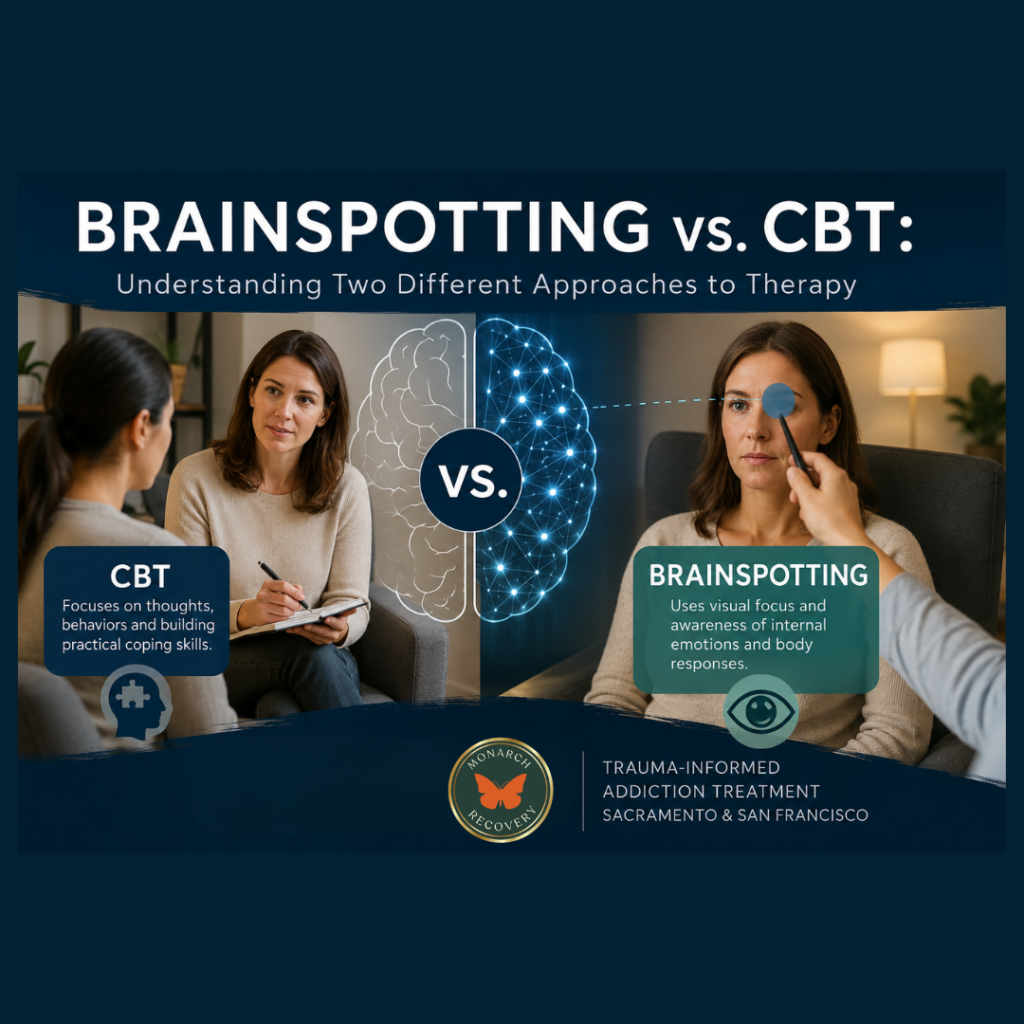
Choosing a therapist can feel complicated enough, but choosing a type of therapy can add another layer of questions. If you’re exploring trauma-informed treatment, you may encounter approaches that sound very different from one another. Cognitive Behavioral Therapy, also known as ‘CBT,’ is a well-established form of psychotherapy centered on connections between thoughts, emotions, and behaviors. Brainspotting is a newer, trauma-focused approach that incorporates visual focus and awareness of internal emotions and physical responses.
Both types of therapy have a place within behavioral health treatment, but they are not interchangeable, and the research supporting each is not equivalent. For someone considering Brainspotting therapy in Sacramento, understanding these differences can make conversations with a treatment provider easier. Rather than asking whether Brainspotting or CBT is ‘better,’ it can be more useful to explore what each approach involves and how a clinician may incorporate different therapies based on a person’s needs, goals, and stage of recovery.
Quick Answer Summary
Brainspotting and Cognitive Behavioral Therapy (CBT) take different approaches to emotional and behavioral health treatment. CBT is a well-established therapy that helps patients identify and change unhelpful patterns of thinking and behavior, while Brainspotting uses visual focus and awareness of internal emotional and physical responses.¹⁴ Brainspotting has shown promising preliminary results, but its research base remains considerably smaller than that of CBT and established trauma-focused therapies.²⁵ The appropriate approach depends on the individual’s symptoms, treatment goals, and broader recovery plan.
Key Takeaways
- CBT is a well-established psychotherapy focused on recognizing and changing patterns among thoughts, emotions and behaviors.¹
- Brainspotting takes a different, more experiential approach, using visual focus alongside awareness of emotional and physical responses.⁴
- The evidence bases are not equivalent: CBT and several CBT-based trauma therapies have extensive clinical support, while Brainspotting research remains comparatively limited and developing.²⁵
- Trauma-informed care is broader than either technique and emphasizes safety, trust, collaboration and treatment that responds to each individual’s experiences and needs.³
- Brainspotting and CBT do not necessarily have to be mutually exclusive. A clinician may incorporate different approaches into an individualized addiction or mental health treatment plan when clinically appropriate.
What is Cognitive Behavioral Therapy?
CBT is a form of psychotherapy built around the relationship between thoughts, feelings, and behaviors. The American Psychological Association (APA) explains that CBT aims to identify and modify unhelpful thought processes and problematic behaviors through cognitive and behavioral techniques.1
In practice, someone participating in CBT may work with a therapist to identify patterns in how they interpret situations. They may examine whether certain beliefs are accurate or helpful, recognize behaviors that reinforce distress, and develop different ways to respond. CBT can also be practical and skills-focused. Depending on why someone is receiving therapy, treatment might involve practicing coping strategies, completing exercises between sessions, changing behavioral patterns, or learning how to approach difficult situations differently.
Importantly, CBT is an umbrella term. Specific cognitive-behavioral treatments have been developed for different conditions. For trauma-related disorders, approaches such as Cognitive Processing Therapy incorporate cognitive principles specifically to address trauma-related beliefs. The VA’s National Center for PTSD identifies several trauma-focused therapies with strong evidence bases, including Cognitive Processing Therapy.2
What is Brainspotting?
Brainspotting takes a noticeably different approach. Developed in the early 2000s, Brainspotting uses specific positions within a person’s visual field while the individual focuses on an emotionally significant experience or concern.
During a session, a therapist may help the client identify a particular visual position, sometimes referred to as a ‘brainspot,’ associated with emotional or physical activation. The client then maintains their visual focus around that position while observing thoughts, feelings, memories, images, or physical sensations that arise.
Brainspotting’s proposed mechanisms suggest that eye position may provide a pathway for accessing and processing trauma-related material. However, these neurological explanations remain hypotheses rather than firmly established mechanisms. An early peer-reviewed paper on Brainspotting itself framed these mechanisms as testable hypotheses.
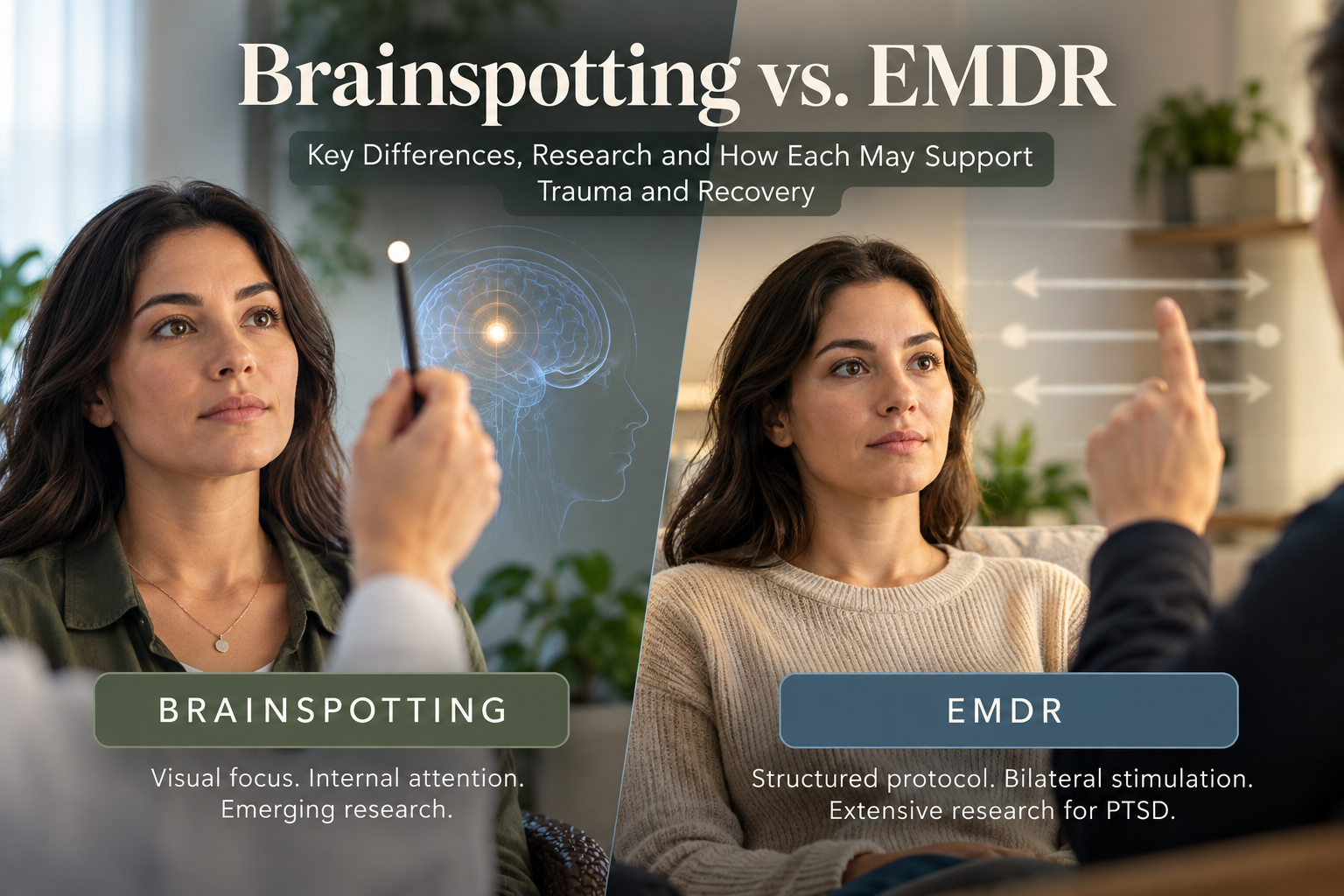
Research into Brainspotting has produced some promising preliminary findings, but the evidence base remains comparatively small. A 2017 study involving 76 adults reported improvements after Brainspotting or EDMR, while more recent research combining Brainspotting with CBT has also called for additional randomized controlled trials before broader conclusions can be drawn.
This distinction is important when discussing Brainspotting therapy Sacramento options. Brainspotting is an emerging therapeutic approach, while CBT and several cognitive-behavioral trauma treatments have been studied more extensively.
How Do Brainspotting and CBT Feel Different in Therapy?
One of the clearest differences involves where attention is directed during a session. CBT often asks patients to actively examine thoughts and behaviors. A therapist might help someone recognize a recurring belief, explore how that belief influences emotions or actions, and practice a healthier or more accurate way of responding.
Brainspotting generally places a greater emphasis on internal observation. Rather than analyzing every thought that appears, the patient may spend portions of the session noticing emotional and physical responses while maintaining a particular visual focus. There may still be conversation with the therapist, but continuous verbal analysis is not necessarily the center of the process.
Neither format automatically makes one therapy more comfortable or appropriate than another. Some people may appreciate having concrete cognitive and behavioral strategies to practice, while others may be interested in exploring a more experiential approach as part of their treatment.
What About Trauma Therapy?
This distinction becomes especially important when someone is seeking trauma therapy Sacramento services. Trauma-informed care is broader than any single therapy. SAMHSA describes trauma-informed approaches as recognizing how trauma can affect people, identifying signs of trauma, integrating that understanding throughout care, and working to avoid retraumatization. Safety, trust, collaboration, and empowerment are central principles.3
CBT-based treatments can fit within this framework, as can other therapeutic approaches. For PTSD specifically, however, the strength of evidence matters. Current VA / DoD guidance identifies Cognitive Behavioral Therapy, Prolonged Exposure, and EMDR as the trauma-focused psychotherapies with the strongest evidence.2 Brainspotting does not currently have a comparable body of clinical research.
However, this does not mean that a clinician can not or should not incorporate Brainspotting into trauma-informed care. Rather, it means that patients should receive an accurate picture of what is established by research and what is still being studied when considering different types of therapies.
Brainspotting and CBT in Addiction Recovery
Trauma and substance use can sometimes overlap, although trauma does not cause every substance use disorder and not everyone receiving addiction treatment has experienced trauma. SAMHSA notes that traumatic experiences can intersect with behavioral health concerns, including substance use, and its guidance encourages providers to recognize the role trauma may play when assessing and planning treatment.³
Within Brainspotting addiction recovery, a clinician might consider Brainspotting when emotional distress or trauma-related experiences are relevant to a person’s broader recovery plan. CBT can play a different role. Someone might use cognitive and behavioral strategies to identify thought patterns connected with substance use, recognize triggers, develop coping skills, or practice different responses to stressful situations.
At Monarch Recovery Centers, Brainspotting therapy Sacramento services are incorporated into individualized treatment when clinically appropriate rather than positioned as a standalone solution. Our intensive outpatient program (IOP) also incorporates evidence-based therapies, including CBT, alongside other approaches to addiction recovery.
Do You Have to Choose Between Brainspotting and CBT?
Not necessarily – behavioral health treatment does not always involve selecting one therapy and using it exclusively. Depending on a person’s circumstances, a clinician may draw from different evidence-based approaches or incorporate complementary techniques within a broader treatment plan.
The right approach may also change over time. Someone in early recovery might initially need practical strategies for managing triggers, establishing routines and responding to cravings. At another point, treatment may place greater emphasis on trauma, relationships, grief, emotional regulation or another underlying concern.
This is why individualized assessment matters more than finding a therapy with the most appealing description. When searching for Brainspotting Sacramento services, patients can ask how Brainspotting fits into the provider’s overall approach, what evidence supports the therapies being recommended, and what other options are available.
Finding the Right Therapy for Trauma and Addiction Recovery
Brainspotting and CBT approach therapy from different directions. CBT has an extensive research base and typically emphasizes recognizing and changing unhelpful patterns of thinking and behavior. Brainspotting is a newer, trauma-focused approach centered on visual focus and internal emotional or physical processing, with an evidence base that is still developing.
The goal does not have to be choosing a winner. Good treatment starts with understanding the person – their history, symptoms, goals, preferences, stage of recovery, and clinical needs can all influence which therapeutic approach makes the most sense.
At Monarch Recovery Centers, trauma-informed addiction treatment can incorporate Brainspotting alongside counseling, intensive outpatient treatment, and other recovery services when clinically appropriate. If you or someone that you love is exploring Brainspotting Sacramento, Brainspotting therapy Sacramento, or other trauma-informed treatment options, contact us today to learn how different therapeutic approaches may fit into an individualized recovery plan.
Citations
- American Psychological Association. Handbook of Cognitive Behavioral Therapy, Volume 1: Overview and Approaches.
https://www.apa.org/pubs/books/handbook-cognitive-behavioral-therapy-vol-1 - U.S. Department of Veterans Affairs, National Center for PTSD. Overview of Psychotherapy for PTSD.
https://www.ptsd.va.gov/professional/treat/txessentials/overview_therapy.asp - Substance Abuse and Mental Health Services Administration. TIP 57: Trauma-Informed Care in Behavioral Health Services.
https://www.samhsa.gov/resource/dbhis/tip-57-trauma-informed-care-behavioral-health-services - Corrigan, F., & Grand, D. (2013). Brainspotting: Recruiting the midbrain for accessing and healing sensorimotor memories of traumatic activation. Medical Hypotheses, 80(6), 759–766.
https://pubmed.ncbi.nlm.nih.gov/23570648/ - Hildebrand, A., Grand, D., & Stemmler, M. (2017). Brainspotting – the efficacy of a new therapy approach for the treatment of Posttraumatic Stress Disorder in comparison to Eye Movement Desensitization and Reprocessing. Mediterranean Journal of Clinical Psychology, 5(1).
https://doi.org/10.6092/2282-1619/2017.5.1376