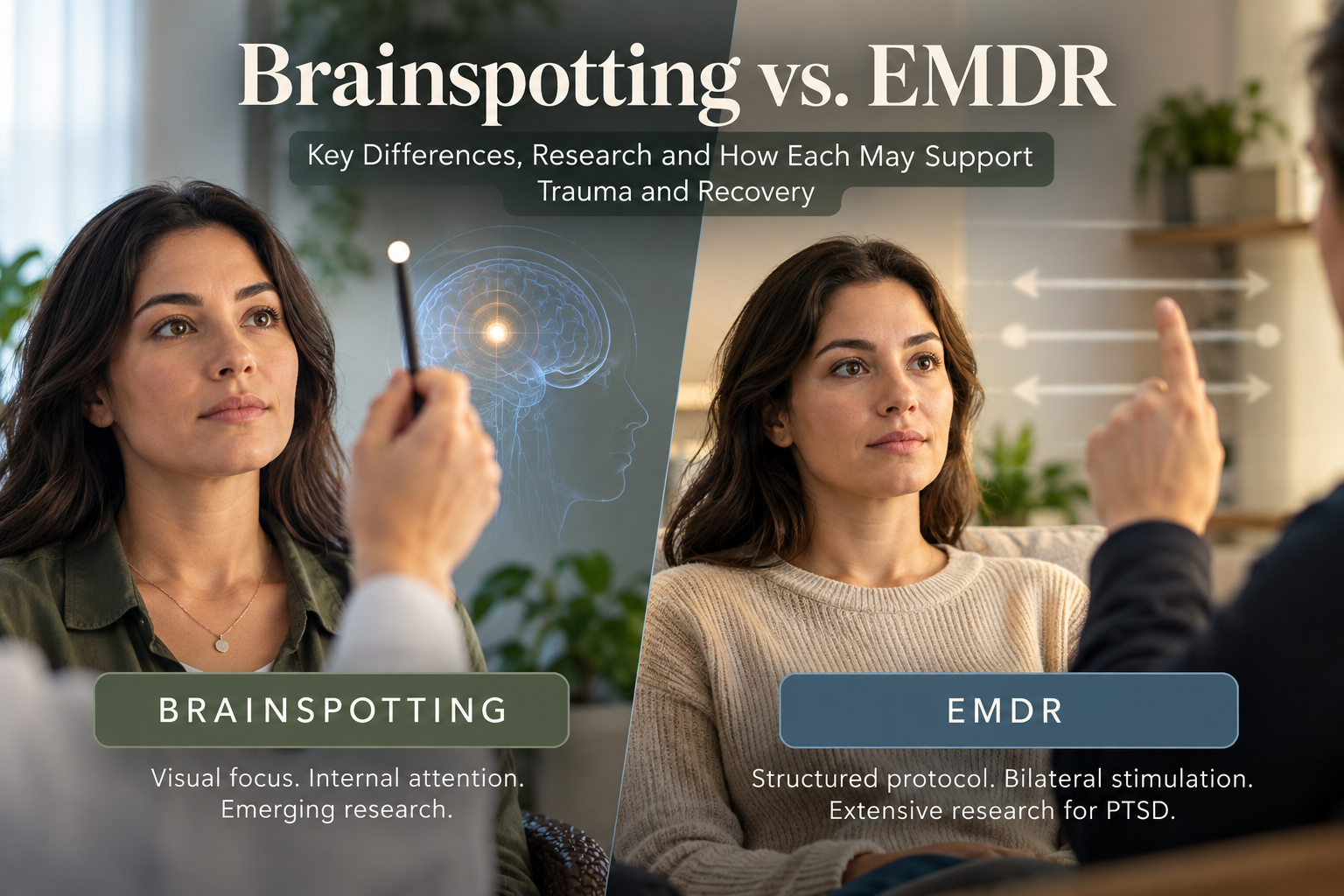


When considering a new type of therapy, one question matters more than almost anything else: Does it work? For Brainspotting, the most accurate answer is that research is still developing. Some early studies have reported some promising results, and some therapists already incorporate Brainspotting into trauma-informed treatment. However, Brainspotting does not yet have the large body of high-quality research available for more established trauma treatments.
This distinction is important. It doesn’t mean that Brainspotting can’t be helpful for an individual patient. Rather, it means that patients should have realistic information about what researchers know, what they are still studying, and how the therapy may fit into a broader treatment plan. For someone considering Brainspotting services in Sacramento for trauma, emotional distress, or addiction recovery, understanding these nuances can make it much easier to have an informed conversation with a therapist.
Quick Answer Summary
Does Brainspotting work? Early research suggests that Brainspotting may offer benefits for some people experiencing trauma-related or emotional distress, but the evidence base is still developing.¹ Brainspotting uses visual focus and awareness of internal experiences as part of the therapeutic process, although its proposed neurological mechanisms remain theoretical.² ³ More established PTSD treatments, including Cognitive Processing Therapy, Prolonged Exposure and EMDR, currently have substantially stronger research support.⁴ ⁵ Brainspotting may still be incorporated into an individualized trauma-informed or addiction recovery plan when clinically appropriate.
Key Takeaways
- Brainspotting research is promising but still limited. A 2025 study found encouraging results when Brainspotting was incorporated into cognitive behavioral therapy, but additional randomized controlled trials are needed before stronger conclusions can be drawn.¹
- Brainspotting’s proposed neurological mechanisms remain hypotheses. Research papers have proposed explanations involving visual attention and neurological processing, but these mechanisms have not been firmly established.² ³
- Established PTSD therapies currently have stronger evidence. Cognitive Processing Therapy, Prolonged Exposure, and EMDR are among the trauma-focused psychotherapies with the strongest clinical evidence and are recommended in current VA/DoD guidance.⁴ ⁵
- Brainspotting may complement broader trauma-informed treatment. A clinician may incorporate it alongside counseling, behavioral therapies, and other services based on an individual’s needs and treatment goals.
- Brainspotting is not a standalone treatment for addiction. Within addiction recovery, it may be used to address relevant trauma or emotional distress while comprehensive treatment continues to address substance use, relapse prevention, coping skills and other recovery needs.
What Is Brainspotting Supposed to Do?
Brainspotting is a therapeutic approach developed by psychotherapist David Grand in 2003. During a session, a therapist typically has a client identify a point within their visual field while focusing on an emotionally meaningful experience or concern. The client may maintain their gaze around that point while noticing thoughts, memories, emotions, images, or physical sensations that arise. Rather than continually analyzing or discussing every reaction, the process can include periods of focused internal observation.3
Brainspotting was developed from the idea that eye position may be associated with how people access and process emotionally significant experiences.2 Researchers and developers have proposed neurological explanations for the technique, but these mechanisms have not been firmly established.
This is why Brainspotting therapy should not be described as unlocking a particular area of the brain or automatically releasing trauma stored in the body. A more accurate description is that Brainspotting combines visual focus, attention to internal experiences, and the therapeutic relationship as part of an experiential approach to processing difficult material.
What Does the Research Say About Brainspotting?
Research into Brainspotting remains relatively small, particularly compared with therapies that have been studied across numerous large randomized controlled trials. However, newer research has begun adding to the evidence base.
A 2025 study published in Psychotherapie Forum evaluated Brainspotting combined with cognitive behavioral therapy following singular stressful or traumatic experiences. Participants were randomized to receive Brainspotting either immediately or later during the treatment process. Researchers found a significantly greater early response among participants who received Brainspotting immediately. By the end of treatment and at follow-up, both groups showed substantial improvements in trauma-related symptoms, while anxiety and depression also improved.1
These findings are encouraging, but there is an important limitation: Brainspotting was being incorporated into cognitive behavioral therapy rather than evaluated completely independently. The study’s author also explicitly cautioned that limitations considerably restricted the generalizability of the findings and concluded that additional randomized controlled trials are necessary. In other words, the study contributes useful evidence, but it does not settle the question of Brainspotting’s effectiveness.
Why Isn’t There a Simple Yes-or-No Answer?
Determining whether psychotherapy ‘works’ is more complicated than determining whether a medication lowers a particular laboratory value. People enter therapy for different reasons. Someone may want to reduce trauma-related distress. Another person may be working on anxiety, emotional regulation, grief, relationships or patterns connected with substance use. Success may therefore look different depending on the person and treatment goal.
Research design matters, too. Researchers need adequately sized studies, appropriate comparison groups, validated outcome measures, follow-up periods, and ideally independent replication before strong conclusions can be made about a treatment.
Brainspotting is still building that evidence base. This is why patients considering Brainspotting therapy Sacramento services should be cautious about claims that this approach is scientifically proven to work for everyone, works faster than established therapies, or directly produces a particular neurological change. The existing research does not support guarantees like those.
What Might You Experience During Brainspotting?
Knowing whether Brainspotting is effective is only one part of deciding whether it is worth discussing with a therapist. Patients may also want to know what the experience is actually like. A Brainspotting session typically begins by identifying an issue, emotion, experience, or pattern to explore. The therapist may ask the client to notice how thinking about the subject affects them emotionally and physically.
From there, the therapist helps identify a visual focal point. The client maintains attention around that location while observing whatever thoughts, emotions, memories, images, or physical sensations emerge. Some people may notice strong emotional reactions, while others may experience subtle shifts or periods when very little seems to happen. There is no particular reaction a patient needs to produce in order for the session to be ‘correct.’
The therapist remains involved throughout the process, helping monitor the patient’s experience, maintain an appropriate pace, and determine how Brainspotting fits with broader therapeutic goals.
Does Brainspotting Work for Trauma?
Brainspotting is frequently discussed in connection with trauma, but patients should understand the difference between a therapy being used for trauma and having extensive evidence demonstrating the effectiveness for a specific trauma-related disorder.
For conditions such as PTSD, other treatments currently have much larger evidence bases. Trauma-focused psychotherapies such as Cognitive Processing Therapy, Prolonged Exposure and EMDR have been studied substantially more extensively and are included in major clinical recommendations.4,5
Brainspotting does not currently have comparable research support. This doesn’t mean that someone seeking trauma therapy Sacramento services should rule it out. A clinician may determine that Brainspotting is appropriate to incorporate into an individualized treatment plan based on the person’s symptoms, preferences, goals, and response to other approaches. The important point is that Brainspotting should not be presented as superior to established trauma treatments simply because its process is different.
Why Might Results Differ From Person to Person?
Even therapies with substantial research support don’t produce identical outcomes for everyone. People differ in their histories, symptoms, diagnoses, current circumstances, treatment goals, support systems, and readiness to explore particular experiences. The relationship with the therapist can play a crucial role as well.
Timing may also be important. For example, someone in the earliest stages of addiction recovery may have different immediate clinical priorities from someone who has developed greater stability and is ready to explore trauma-related experiences more deeply. At Monarch Recovery Centers, Brainspotting therapy services in Sacramento are incorporated into individualized care when clinically appropriate rather than automatically recommended to every patient.
What About Brainspotting and Addiction Recovery?
The evidence for Brainspotting as a specific treatment for substance use disorders is even more limited. Brainspotting should therefore not be viewed as a replacement for comprehensive addiction treatment.
Instead, Brainspotting addiction recovery services may be considered when trauma, emotional distress, grief, chronic stress, or related experiences are relevant to someone’s broader treatment needs. For example, a person may be learning to recognize triggers and develop healthier coping strategies through addiction counseling while also working with a therapist on emotionally difficult experiences that continue to affect their recovery.
In this situation, Brainspotting may complement rather than replace other services. At Monarch, Brainspotting can be incorporated alongside counseling, behavioral therapies, relapse-prevention work, and Intensive Outpatient Program services when appropriate. This broader treatment framework matters because addiction recovery rarely hinges on one therapeutic technique.
How Do You Know Whether Brainspotting Is Worth Trying?
Rather than asking only, ‘Does Brainspotting work?; it may be more useful to ask whether Brainspotting makes sense for your particular treatment plan. A qualified clinician can consider what symptoms or concerns you want to address, whether you have a specific diagnosis, what treatments you have previously tried, how you respond to them and what approaches have the strongest evidence for your needs.
Patients can also ask a therapist why they are recommending Brainspotting, what training they have received, what goals they hope to address, how progress will be evaluated, and what other treatment options are available. These conversations turn treatment into a collaborative decision rather than a leap of faith.
For someone participating in addiction treatment through an IOP, the same principle applies. Brainspotting can be evaluated within the context of the person’s overall recovery plan rather than completely in isolation.
Is Brainspotting Worth Exploring as Part of Your Recovery?
So, does Brainspotting work? Early research suggests potential benefits and gives researchers good reason to continue studying the approach. At the same time, evidence remains limited, and additional high-quality randomized controlled trials and independent research are needed before stronger conclusions can be drawn. For individual patients, the answer may depend on what they are trying to address, where they are in the healing process, how they respond to the approach, and what other treatment they are receiving.
At Monarch Recovery Centers, Brainspotting Sacramento services may be incorporated into trauma-informed addiction treatment when clinically appropriate. Brainspotting can be used alongside counseling, IOP, and other recovery services rather than positioned as a single solution for trauma or addiction.
If you’re curious about Brainspotting, contact us today to learn more about the approach and discuss whether it may have a place within your individualized treatment and recovery plan.
Citations
- Glantschnig S. Brainspotting after singular stressful/traumatizing experiences: Evaluation of a combination of Brainspotting and cognitive behavioural therapy. Psychotherapie Forum. 2025;29:59–66. doi:10.1007/s00729-025-00275-5. https://link.springer.com/article/10.1007/s00729-025-00275-5
- Corrigan F, Grand D. Brainspotting: Recruiting the midbrain for accessing and healing sensorimotor memories of traumatic activation. Medical Hypotheses. 2013;80(6):759–766. doi:10.1016/j.mehy.2013.03.005. https://pubmed.ncbi.nlm.nih.gov/23570648/
- Corrigan FM, Grand D, Raju R. Brainspotting: Sustained attention, spinothalamic tracts, thalamocortical processing, and the healing of adaptive orientation truncated by traumatic experience. Medical Hypotheses. 2015;84(4):384–394. doi:10.1016/j.mehy.2015.01.028. https://pubmed.ncbi.nlm.nih.gov/25665861/
- Substance Abuse and Mental Health Services Administration. Trauma-Informed Care in Behavioral Health Services, Treatment Improvement Protocol (TIP) Series 57. https://library.samhsa.gov/sites/default/files/sma14-4816.pdf
- U.S. Department of Veterans Affairs, National Center for PTSD. Overview of Psychotherapy for PTSD. https://www.ptsd.va.gov/professional/treat/txessentials/overview_therapy.asp